
Dr. Wolfgang Rath
Empirie ist und bleibt die Königsdisziplin der Wissenschaft. Diese Überzeugung treibt mich an, pragmatische Lösungen zu finden, etwa um funktionalisierte Nukleinsäuren für die klinische Anwendung nutzbar zu machen. Dabei plane ich mehrschrittige Syntheserouten und entwickle analytische Methoden mit breiter Kompetenz von NMR bis HPLC.
Empiricism is, and remains, the highest discipline of science. This conviction drives me to find pragmatic solutions, for example in the pursuit of making functionalized nucleic acids usable for clinical applications. To this end, I plan multi-step synthesis routes and develop analytical methods with broad expertise ranging from NMR to HPLC.
KompetenzenCompetencies
Synthese & Molekulares DesignSynthesis & Molecular Design
ChromatografieChromatography
Spektroskopie & MSSpectroscopy & MS
Größen- und StrukturanalytikSize & Structure Analysis
Führung & OrganisationLeadership & Organization
Regulatorik & Industrie-ToolsRegulatory Affairs & Industry Tools
Scripting und Workflow-AutomatisierungScripting and Workflow Automation
Forschungs-ProjekteResearch Projects
Ultraschall-aktivierte Freisetzung von NukleinsäurenUltrasound-activated release of nucleic acids
Externe Aktivierung eines DNAzymsExternal activation of a DNAzyme
DNAzyme sind katalytisch aktive Nukleinsäuren, die Anwendung in der Gentherapie und Bildgebung finden.
Zur Erhöhung der Stabilität und Vermeidung von Off-Target-Effekten können sie mit Trägersystemen kombiniert werden.
Externe Trigger wie Licht ermöglichen eine gezielte Aktivierung, sind aber in ihrer Gewebe-Eindringtiefe limitiert.
Ultraschall (US) ist ein hervorragender nicht-invasiver Trigger für biologische Systeme aufgrund seiner hohen Eindringtiefe.
Im klinischen Kontext wird aus Sicherheitsgründen nur US mit niedriger Intensität eingesetzt, was den Einsatz von Polymer-Mechanochemie mit diesen US-Geräten erschwert.
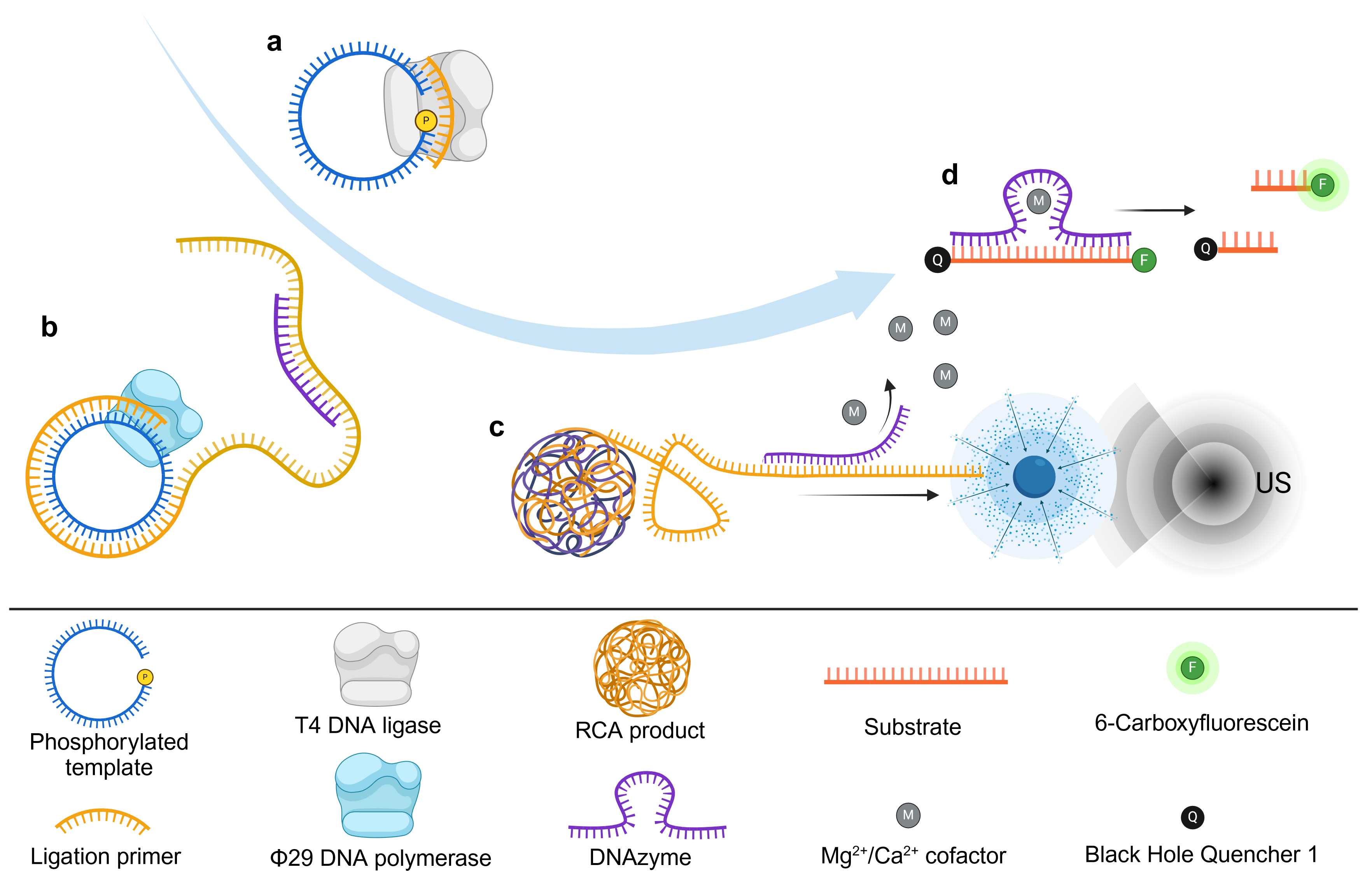
Aus diesem Grund haben wir Systeme auf Grundlage von Rolling Circle Amplification (RCA) entwickelt, die gezielt mit niedriger US-Intensität aktiviert werden können.
DNAzymes are catalytically active nucleic acids used in gene therapy and bioimaging.
To increase stability and avoid off-target effects, they can be combined with carrier systems.
External triggers such as light enable targeted activation but are limited in tissue penetration depth.
Ultrasound (US) is an excellent non-invasive trigger for biological systems due to its high penetration depth.
In a clinical setting, only low-intensity US is used for safety reasons, which complicates the use of polymer mechanochemistry with these US devices.
For this reason, we developed systems based on Rolling Circle Amplification (RCA) that can be specifically activated with low US intensity.
DNA-Nanostrukturen in der Cancer Drug DeliveryDNA nanostructures in cancer drug delivery
Theranostik-Plattform für GlioblastomTheranostic platform for glioblastoma
Aptamere sind funktionale Nukleinsäuren, die mit spezifischen Targets wie Rezeptoren interagieren.
Sie können genutzt werden, um Wirkstoffe gezielt in bestimmte Zelltypen zu transportieren (Drug Delivery).
Diese Methode wird bereits in der Krebstherapie eingesetzt, um Nebenwirkungen von Chemotherapien zu mildern und deren Effektivität zu steigern.
In der Praxis leidet die Wirksamkeit von Aptamer-Wirkstoff-Konjugaten jedoch häufig unter Nuklease-Abbau und renaler Ausscheidung.
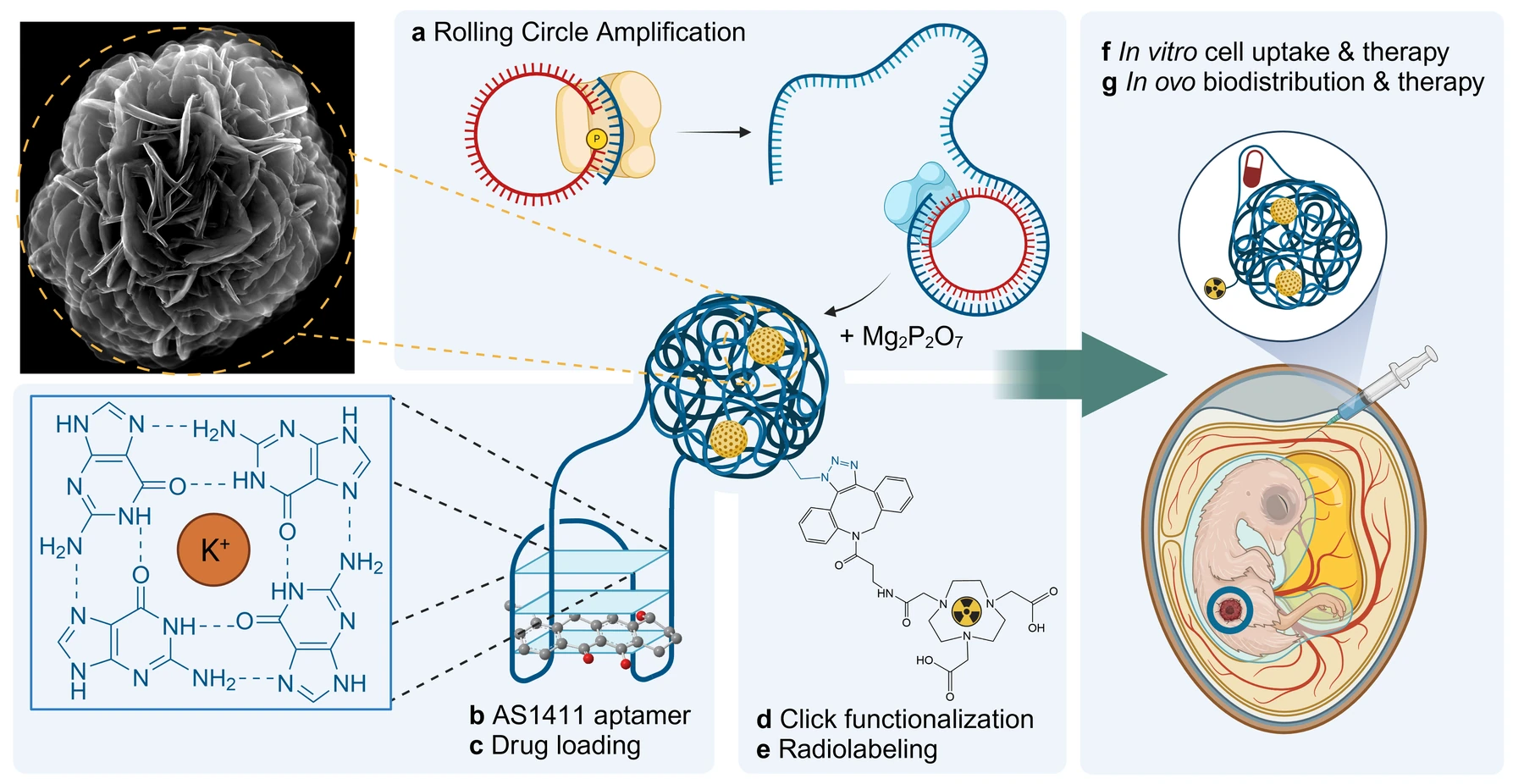
Wir haben ein aptamerbasiertes Drug-Delivery-System auf Basis von Rolling Circle Amplification (RCA) entwickelt, das durch seine Größe nicht renal gefiltert wird und erhöhte Nuklease-Resistenz aufweist.
Zusätzlich haben wir das System mit einem Chelator für radioaktive Isotope funktionalisiert, was PET-Bildgebung sowie eine kombinierte Chemo- und Strahlentherapie ermöglicht.
Aptamers are functional nucleic acids that interact with specific targets such as receptors.
They can be used to deliver drugs specifically into certain cell types (drug delivery).
This method is already used in cancer therapy to reduce chemotherapy side effects and increase their effectiveness.
In practice, however, the efficacy of aptamer-drug conjugates often suffers from nuclease degradation and renal clearance.
We developed an aptamer-based drug delivery system based on Rolling Circle Amplification (RCA) that, due to its size, is not renally filtered and shows increased nuclease resistance.
In addition, we functionalized the system with a chelator for radioactive isotopes, enabling PET imaging as well as combined chemo- and radiotherapy.
DNA-Markierungsmoleküle für Cancer ImagingDNA labeling molecules for cancer imaging
Signalverstärkte Aptamere für MRTSignal-enhanced aptamers for MRI
Neben Drug-Delivery-Applikationen können Aptamere genutzt werden, um Kontrastmittel für Bildgebungsverfahren gezielt in bestimmten Geweben anzureichern.
Para-Hydrogen-Induced Polarization (PHIP) ist eine Methode zur Verstärkung der Kernspin-Magnetisierung und eignet sich besonders zur Signalverstärkung in portablen MRT-Geräten mit geringer Magnetfeldstärke.
Bisherige Ansätze zur Herstellung PHIP-markierter Aptamere basierten auf einer aufwendigen Bottom-up-Synthese, die für jede neue Sequenz wiederholt werden muss.
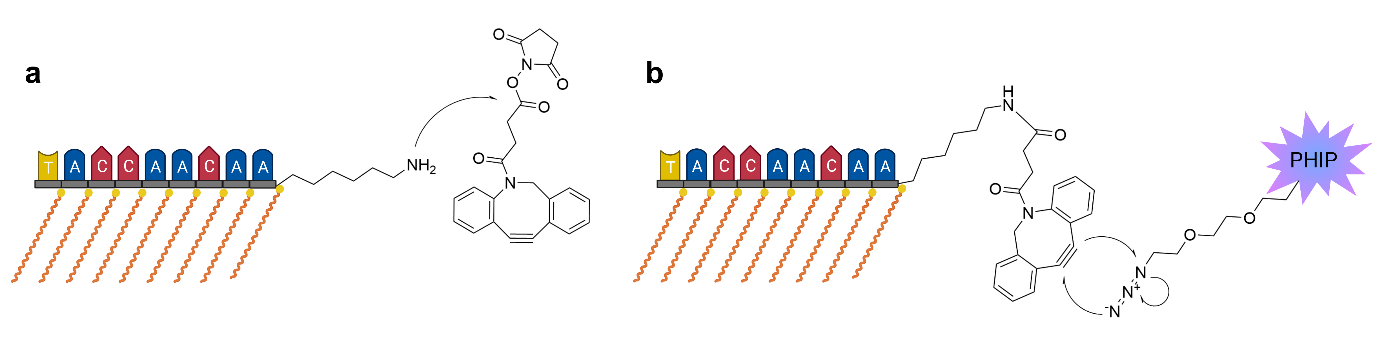
Wir haben stattdessen eine modulare Syntheseroute entwickelt, bei der der PHIP-Marker per Click-Chemie nachträglich angebracht wird.
Besides drug delivery applications, aptamers can be used to specifically enrich contrast agents for imaging methods in certain tissues.
Para-Hydrogen-Induced Polarization (PHIP) is a method for enhancing nuclear spin magnetization and is particularly suited for signal enhancement in portable MRI devices with low magnetic field strength.
Previous approaches to producing PHIP-labeled aptamers relied on an elaborate bottom-up synthesis that has to be repeated for every new sequence.
Instead, we developed a modular synthesis route in which the PHIP label is attached afterwards via click chemistry.
PublikationenPublications
-
W.H. Rath, R. Göstl, A. Herrmann, "Mechanochemical Activation of DNAzyme by Ultrasound"
-
A. Ishaqat et al., "In Vivo Polymer Mechanochemistry with Polynucleotides"
-
D. Van Craen, W.H. Rath et al., "Chasing Weak Forces: Hierarchically Assembled Helicates as a Probe for the Evaluation of the Energetics of Weak Interactions"
WerdegangCareer
| ZeitraumPeriod | StationPosition | Institution |
|---|---|---|
| 04/2021–12/2025 | Doktorand, Laborleitung Nukleinsäure- und SyntheselaborPhD candidate, lab head of the nucleic acid & synthesis lab | RWTH Aachen / DWI Leibniz-Institut |
| 10/2016–12/2020 | Master ChemieMaster's in Chemistry | RWTH Aachen |
| 10/2012–08/2016 | Bachelor ChemieBachelor's in Chemistry | RWTH Aachen |